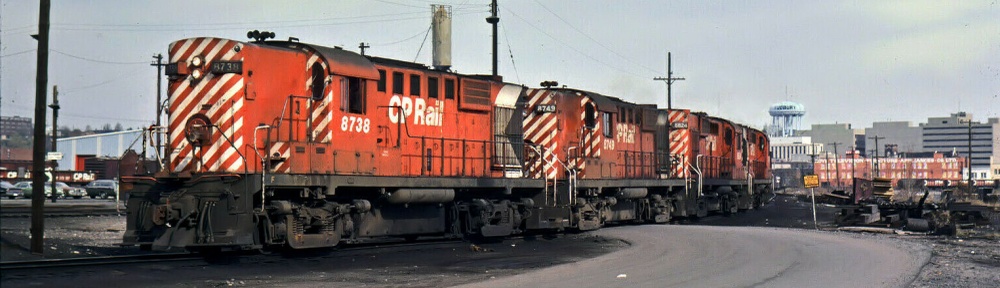
System Operating Plans General Instructions for High Reliability Trains 901,902,921,949,951,952,953,965

System Operating Plans General Instructions for High Reliability Trains 901,902,921,949,951,952,953,965

The objective with these trains is to place all cars on schedule at the
consignee’s siding. The minimum goal will be on-time placement of 85% of the
Group “A” traffic (Pool, Piggyback, Containers, Perishables and Automobiles
as specified for each train). The measurement is made weekly and on an annual
basis by comparing daily placements of cars with the scheduled placement times.

Marketing and Sales and Operating personnel will ensure that shippers are
informed that cut-off times must be met if scheduled delivery is to be consistently
achieved.

The plan of operation covers movement from dock to dock (or to interchange point).
Terminal operations must be planned to provide car handling at origin and destination
within the established car schedules.

In order that these measurements can be made, daily reports are to be telephoned
to the System Operations Centre from Vancouver, Calgary, Regina, Winnipeg, Thunder
Bay, Toronto, Montreal and Saint John giving the following car placement data for
Group “A” traffic:

  • Total cars placed
  • Total cars placed late
  • Time of placement of late cars only
  • Reason for late placement

Time of placement will be defined as time that first car or cut of cars is placed.

The power-to-weight ratio must not fall below that specified.

Train symbols must not be changed enroute. If sections are required the first
section must be the through train.

Detailed operating and marshalling instructions will be issued by the Chief of
Transportation as required.

These trains must operate to the requirements laid out in the detail pages.

NOTE: No changes are to be made to the operating plans detailed herein without
the authority of the Chief of Transportation.

Traffic

For Group “A” traffic the individual commodity priority list for above mentioned
high reliability trains indicate the order of preference to be given commodities.
(The first item in the list has highest priority). Where more traffic is available
than authorized capacity, first reduction should be made to other than Group “A”
traffic. Where Group “A” traffic exceeds the car limit, reduction will be made by
first considering the blocks of cars in origin/destination blocks (long haul has
preference). Secondly, within each reduction by origin/destination, traffic should
be given preference in the order listed in the individual commodity priority lists.
Where marshalling procedures permit, loads should be given preference.

Recent Posts

Layout Update and 2026 Doubleheaders Tour

It’s that time of year again, our layout will be open to the public this coming Saturday, 28 March 2026, in participation with the annual Kitchener-Waterloo-Cambridge-Guelph and area layout tour, organized by the Doubleheaders Model Railway Club. This is a self-guided tour of a large number of club and private home layouts in the area.

If you are new to the Doubleheaders tour there are approximately 20 different layouts you can visit, varying from modular displays, large club setups to small N-scale pikes. You can see everything from tinplate trains to scratch-built prototype models. However the layouts are spread over a large area, and that makes it difficult to see them all in a day. So you should prepare for a full day of layout touring, and also maybe consider making this an annual, or at least semi-annual event to frequent over the years.

Please note; some layout are open until 9PM, however the CP Sudbury Division closes early at 5PM. If you are taking this year’s tour, please plan accordingly.

As usual we’ve been working on an number of layout projects over the winter in anticipation of the tour, at least as best as this year’s weather would permit. To start, we’ve completed the base scenery at our INCO – Crean Hill mine scene (photo above). If anything says ‘CP Rail in Sudbury’, it’s nickel ore trains; and not only do we have a large fleet of appropriate ore gons in service, but we now have a nicely sceniced mine for them to operate in. Well, as nice as an industrialized hole in the ground can look.

We also have a lot more carpentry happening upstairs as our layout expands to the second floor. The above photo shows what we’ve named the Verner helix, though like many of our helices it is actually connecting many different sections of the layout together. If you want the details, you’ll need to visit us and ask one of our friendly club members to find out. You will also see the new rails being laid at Levack, the benchwork at Sturgeon Falls along with the associated trackage at the Abitibi Paper mill located there, and much more.

Of course the feature attraction is seeing the fully operational portions of our CP Sudbury Division layout in action, with long sound-equipped freights running smoothly under DCC control. This is your chance to interact with us; to swap stories, exchange ideas, share techniques, and to celebrate the art of railway modelling, because that is always the best part of the world’s greatest hobby.

Hope to see you on the tour.

  1. Evolution of an Image – CP Freight Car Paint Schemes Leave a reply
  2. In Memorial: Jim ‘Skid’ Robinson Leave a reply
  3. 2025 Fall Open House Leave a reply
  4. 2025 Doubleheaders Layout Tour – Saturday March 29th, 2025 2 Replies
  5. Out With the Old, In With the New 3 Replies
  6. Falconbridge Nickel Mines Railway Leave a reply
  7. INCO Ore Operations on the Sudbury Division Leave a reply
  8. State of the Layout – March 2024 Leave a reply
  9. WRMRC Fall Open House – Saturday 14 October 2023 Leave a reply