Sudbury Division Train Number of the 1970s

Trains of the Sudbury Division in the 1970s


Passenger

Symbol Origin Destination Notes
1 Montreal, QC Vancouver, BC “The Canadian”
2 Vancouver, BC Montreal, QC “The Canadian”
11 Toronto, ON Sudbury, ON “The Canadian” – Toronto Section
12 Sudbury, ON Toronto, ON “The Canadian” – Toronto Section
417 Sudbury, ON White River, ON White River Budd RDC run
418 White River, ON Sudbury, ON White River Budd RDC run
427 Sudbury, ON Sault Ste Marie, ON S.S.Marie Budd RDC run
428 Sault Ste Marie, ON Sudbury, ON S.S.Marie Budd RDC run
 

Inter-Division Freights

Symbol Origin Destination Notes
901 Toronto, ON (Parkdale) Vancouver, BC (Coquitlam) Intermodal, express & Autorack train
902 Vancouver, BC (Coquitlam) Toronto, ON (Parkdale) Intermodal, express & Autorack train
911 Montreal, QC (St Luc) Sault Ste Marie, ON Manifest – Connects with SOO #911 to Schiller Park,IL (Chicago)
912 Sault Ste Marie, ON North Bay, ON Manifest – Traffic east of North Bay lifted by # 952
921 Toronto, ON (Agincourt) Winnipeg, MB Pool (l.c.l.), Intermodal & Manifest traffic
925 Montreal, QC (St Luc) Thunder Bay, ON Manifest. Replaced 951 in 1975.
946 Winnipeg, MB Toronto, ON (Agincourt) Stock (in season) & Manifest (paper loads and eastern empties). Replaced in 1975 by 956.
949 St.John, NB (Bayshore) Calgary, AB (Alyth) Intermodal/Pool/Perishables – via Chalk River line from Montreal
951 Montreal, QC (St Luc) Vancouver, BC (Coquitlam) Pool/Intermodal/Manifest – lifts west of Winnipeg traffic off 921 & 953. Replaced by 925 in 1975.
952 Calgary, AB (Alyth) St.John, NB (Lancaster) Intermodal/Perishables/Autorack train – via Chalk River line to Montreal
953 Toronto, ON (Agincourt) Winnipeg, MB Pool (l.c.l.), Autorack & Manifest. Runs as required with overflow from 921 and 965. Extended to Calgary in 1975.
954 Calgary, AB (Alyth) Toronto, ON (Agincourt) Pool (l.c.l.), Stock & Manifest. Handles overflow from 902 and 952; sets off Montreal/East and Sudbury traffic at Cartier for #974
955 Toronto, ON (Agincourt) Sudbury, ON Manifest (local cars for Sudbury & North Bay area)
956 Winnipeg, MB Toronto, ON (Agincourt) Pool (l.c.l.) & Manifest. Replaced 946 in 1975.
965 Toronto, ON (Agincourt) Vancouver, BC (Coquitlam) Intermodal, Autorack & Pool (l.c.l.) traffic
967 / P.A.T. Toronto, ON (Agincourt) Vancouver, BC (Coquitlam) “Pacific Auto Train” semi-daily unit autorack train
974 Cartier, ON Montreal, QC (St.Luc) Manifest (Montreal set-off from # 954)
 

Local Freights & Turn Jobs

Symbol Origin Destination Notes
50 Sudbury, ON Toronto, ON (Agincourt) Counterpart to # 955, mainly hauled empties, listed within CP freight procedures book as ’50’ but was operated under any timetable schedule
73 Sudbury, ON Little Current, ON Recovered INCO iron ore in coal hoppers to Turner docks
74 Little Current, ON Sudbury, ON Coal from Turner docks, trains 73/74 were also called the ‘Little Current Turn’ or ‘The Coal Train’ by crews
 96 Webbwood, ON Sudbury, ON Extension of Thessalon Sub locals # 88/89 – a SOO/Sudbury swing job serving local industries
Espanola Turn Sudbury, ON Espanola, ON (E.B.Eddy) Turn job exclusively for E.B.Eddy paper mill in Espanola
North Bay Turn Sudbury, ON North Bay, ON A Cartier Sub east-end turn job, traffic was mainly for Abitibi-Price paper mill in Sturgeon Falls and ONR interchange at North Bay
Phelans Turn Sudbury, ON Phelans, ON As required turn job for aggregate pit at Phelans, crews also called it ‘The Stone Train’
INCO Job#1 Sudbury, ON Creighton Mine (INCO) INCO Clarabelle-Creighton nickel/copper ore shuttle
INCO Job#2 Sudbury, ON Crean Hill Mine (INCO) INCO Clarabelle-Crean Hill nickel/copper ore shuttle
INCO Job#3 Sudbury, ON Levack Mine (INCO) INCO Levack-Sprecher nickel/copper ore shuttle
The “Falcon” Sudbury, ON Falconbridge, ON Turn job exclusively for Falconbridge Ltd, mainly handled matte hoppers and dolomite (a flux used in the smelter)
Strathcona Turn Sudbury, ON Strathcona Mine – Falconbridge Falconbridge nickel concentrate hoppers, crews and railfans often called it ‘The Slurry Train’
 

Unit Trains *

Train Origin Destination Notes
Pulp Train Cartier (Ramsey), ON Nairn, ON (E.B.Eddy) Turn job – tree length pulpwood for Eddy plant at Nairn Centre
Kidd Creek Acid North Bay, ON Various Unit sulphuric acid off ONR to various destinations
Copper Cliff Acid Sudbury, ON Various Unit sulphuric acid from INCO to various destinations
Grain Extras Thunder Bay, ON Quebec,QC (or) St.John, NB Winter Only – during St.Lawrence Seaway shutdown
Potash Extras Various (Western Canada) Various (Southern Ontario) Seasonal movements from various mines to farm co-ops in Ontario
* Note: Symbols were given to these trains, but they were often unused by crews or dispatchers
 

Recent Posts

Evolution of an Image – CP Freight Car Paint Schemes

Like any company or institution that’s been around for a long time, Canadian Pacific has gone through a number of image and branding changes over the years. This article will look at the various rolling stock paint schemes used by Canadian Pacific over the last century.

Early Block (<1951)

CP’s lettering standard from the early half of the 20th century featured the Canadian Pacific name in simple gothic block lettering. There were variations in how this lettering was positioned depending on the car type or era, but they all used the same stencils and this was more or less standard from at least the WWI through WWII periods.

CP Spans the World (1947-1951)

Starting in 1947, this “CPR Spans the World” herald and slogan were introduced by CPR’s marketing highlighting CP’s steam ship connections that connected the railway to Europe and Asia. A number of boxcars repainted during 1947-1950 received this herald prominently applied to the right of the car side. Otherwise, the lettering was identical to the previous standard “block” lettering scheme, just with the addition of the “Spans the World” herald.

Due to the size and prominence of the herald, this was only applied to boxcars, with no change to the paint scheme on any other type of car.

Stepped Gothic (1951-1962)

CP’s standard boxcar scheme throughout the 1950s featured the railway’s name in “stepped” offset rows on the right hand side of the car, with the “CPR” initials prominently emphasized. Even though unaffiliated with the CPR at the time, the Pacfic Great Eastern and Toronto, Hamilton & Buffalo railways would also copy this idea, introducing their own similar lettering schemes with stepped lettering.

Like the late 1940s “Spans the World” graphic, this was only applied to “house” cars like box cars and refrigerators, with other car types like hoppers, gondolas, and cabooses continuing to carry the simple block lettering above.

A minor change to this scheme would come in 1957 when the horizontal white lines above and below the car number, previously an AAR standard, were discontinued.

The Script Era (1963-1969)

CP had used a version of script lettering in marketing logos going back to the early 20th century, but in the early 1960s the script lettering was revised and the railway’s image updated to make wide use of it as their primary branding, applying the new lettering to locomotives, freight cars, cabooses, ships and trucking divisions, and all company paper work.

Freight car colours remained the same: brown for box and other “house” cars, and black for open cars like flatcars, gondolas, and hoppers. Cabooses remained brown with red ends. Only the logos applied to the cars changed.

This lettering change was applied to most car types on the CPR except for flatcars, which continued to use the simple block lettering as the script lettering would not fit on this type of car. Also while some groups of new gondolas delivered later in the 1960s were delivered in the new script lettering, CP shops were loath to actually do any painting of the script lettering over car ribs, and there is little or no evidence of actual CP shop repaints of any cars with external bracing with script lettering.

A Colourful Introduction (1967-1968)

Starting in 1966 CP started to modify their script scheme for several large purchases of new freight cars in the late 1960s. The size of the reporting marks and car numbers were increased and the font modified slightly. They also introduced bold colour coding to several types of cars (mainly box type cars).

New mechanical refrigerator cars were painted silver with red lettering. Insulated heated boxcars were painted a striking yellow-orange with red script. And a large group of boxcars dedicated to paper service were delivered in a jade green scheme with a large pine tree graphic.

Cabooses also got a colourful upgrade, with several cabooses repainted during this period into a bright red with yellow ends. However due to the short-lived period these paint schemes were applied, no existing freight cars are ever known to have been repainted in similar schemes to any of the above cars. These schemes only appeared on newly built cars.

Flatcars, gondolas, and hoppers (other than a group of pressure-differential unloading hoppers which were painted in a silver and black scheme) remained black, but deliveries from around 1967 can be noted for the subtle change in the reporting mark/number font and size.

The CP Rail Era (1969-1987)

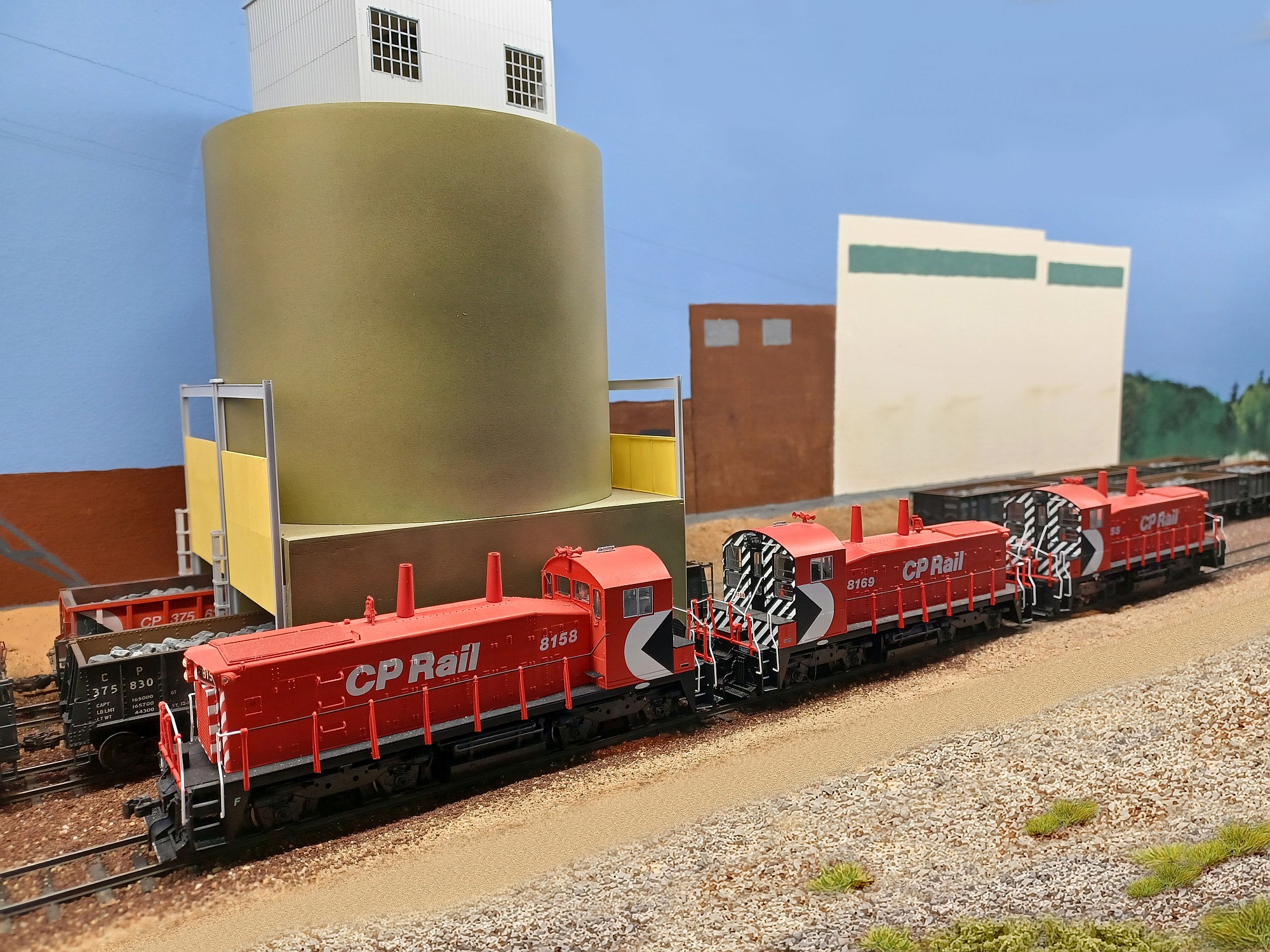
In October 1968, Canadian Pacific introduced their most radical rebranding in company history. All of the company’s divisions dropped the classic script lettering, and adopted a unified branding with a new name consisting of the parent company’s “CP” initials followed by the division name, and new logo called the “MultiMark”, with each division using the same logo but with their own colour. Canadian Pacific Railway became “CP Rail”, and adopted red as their primary colour. (The specific shade of red to become known as “Action” red.)

On the railway, this lead to a radical change in the colour landscape, with maroon and grey locomotives giving way to red (although note the black locomotive model in lead graphic in this section – this was the original proposal which CP management rejected) and brown and black freight cars shifting to brighter colours.

Locomotives and most freight equipment (boxcars, gondolas, and flatcars) was painted in the CP Rail “Action Red” colour which was adopted as the railway’s primary colour, matching the locomotives. The company’s bold new black and white “MultiMark” logo was applied at one end of the car covering the full height of the car side. (The paint standard had the MultiMark at the “B” (handbrake) end of the car, although many boxcar repaints just put it to the left of the car side as it was easier to mask over a pair of grabs than a full ladder.) Early box car repaints featured a contrasting black lower sill, which was dropped on later repaints which just kept the lower sill the same colour as the rest of the body.

Several other colours were used however. Following the colour coding introduced with the 1967 schemes above, paper service assigned boxcars received a green paint scheme, insulated heated cars as well as cabooses were yellow, and refrigerator cars were painted silver. Hopper cars were still painted black. The last two car types received a modified version of the MultiMark, with Action Red used instead of black for the triangle in the logo.

Interestingly, the “CP Rail” brand also started a trend among other unrelated Canadian Railways, with British Columbia Railway renaming itself “BC Rail” in the early 1980s, Canadian National briefly experimented with “CN Rail” branding in the late 1980s, and Ontario Northland introduced a bold new “ON Rail” image for their locomotive paint scheme in the early 2000s.

The Loss of the MultiMark (1987-1996)

The MultiMark logo lasted for almost 20 years before CP decided to remove it from their branding in late 1987. (The first locomotive to be outshopped in a new paint job without the MultiMark was in November 1987.)

While the “CP Rail” name and branding would still last another decade before reverting back to a version of “Canadian Pacific” branding, the MultiMark symbol was now a thing of the past. In the early 1990s, CP would modify their CP Rail logo to “CP Rail System” featuring a split Canadian and US Flag (known to railfans as the “Dual Flags” scheme), although this logo is not known to have ever been applied to freight equipment, only locomotives and maintenance vehicles.

The Return to Canadian Pacific (1997-2023)

In 1997 CP finally retired the “CP Rail” brand for good, moving to a modern interpretation of the Canadian Pacific Railway name and classic beaver herald. There would be some experimentation, with the beaver logo occasionally being dropped and restored and going through some minor styling updates, but this would more or less be CP’s branding until the 2023 merger with Kansas City Southern to form CPKC Railroad, which currently uses a modified version of the CP beaver logo with the CPKC initials instead of CP.

  1. In Memorial: Jim ‘Skid’ Robinson Leave a reply
  2. 2025 Fall Open House Leave a reply
  3. 2025 Doubleheaders Layout Tour – Saturday March 29th, 2025 2 Replies
  4. Out With the Old, In With the New 3 Replies
  5. Falconbridge Nickel Mines Railway Leave a reply
  6. INCO Ore Operations on the Sudbury Division Leave a reply
  7. State of the Layout – March 2024 Leave a reply
  8. WRMRC Fall Open House – Saturday 14 October 2023 Leave a reply
  9. Begin/End CTC Romford 2 Replies